

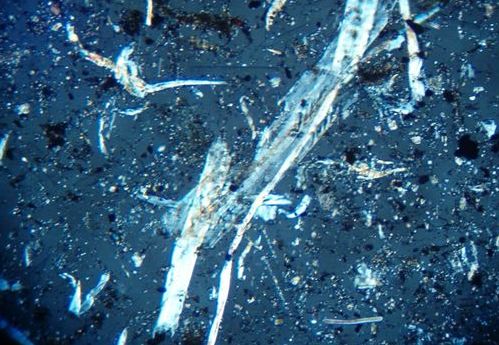
Non‑volatile organic compounds (NVOCs) are organic chemicals with extremely low vapor pressure, meaning they do not meaningfully evaporate under normal workplace conditions. When released into air, they remain as solid or liquid particles—behaving as dusts, mists, or aerosols rather than vapors. In occupational hygiene, this places them in the same sampling category as particulate contaminants.
What Defines a Non‑Volatile Organic Compound
NVOCs are typically identified by two physical properties:
- Boiling point above ~350 °C — high enough that the substance will not transition into vapor at ambient temperatures.
- Saturated vapor pressure below ~0.0001 Pa — too low to produce measurable vapor in air.
Because of these characteristics, NVOCs disperse as particulate matter. They require filter‑based sampling, not sorbent tubes or vapor‑phase media.
This distinction matters for exposure assessment: even though these materials are organic, they behave like dusts or mists in air and must be sampled accordingly.
How NVOCs Fit Into Airborne Contaminant Categories
Airborne organic contaminants are commonly grouped into four classes:
- Gases
- Vapours
- Semi‑volatile organic compounds (SVOCs)
- Non‑volatile organic compounds (NVOCs)
NVOCs sit at the “particulate” end of this spectrum. They do not evaporate, they do not form vapor clouds, and they do not require thermal desorption or solvent extraction from sorbent tubes. Instead, they are collected on filters, cassettes, or impingers depending on the physical form of the aerosol.
Examples of NVOCs Encountered in Air Quality and IH Work
Many industries generate NVOCs during routine operations. Common examples include:
- Cellulose — paper processing, textiles, insulation
- Metalworking fluids — machining, grinding, cutting operations
- Oil mist — lubrication systems, compressors, hydraulic equipment
- Paraffin wax — candle manufacturing, coatings, packaging
- PVC dust — plastics fabrication, cutting, sanding
- Tetrahydrocannabinol (THC) — cannabis cultivation and processing
- Vitamins and nutraceutical powders — supplement manufacturing
- Wood dust — carpentry, milling, furniture production
Each material has its own sampling considerations: particle size, expected concentration, recommended filter type, and analytical method.
Support for Sampling and Method Selection
LCS Laboratory provides hundreds of analytical tests used in air quality studies, industrial hygiene assessments, and EHS investigations. We continue to publish individual test pages, and our pricelist remains the most complete and current reference for all available analyses. If you need help choosing sampling media, selecting the correct method, or obtaining a quote, you can email us anytime. ©


